From time to time— and probably not often enough— I visit my sister, Jen, and her family in Iowa.
It’s not just anywhere in Iowa. Around 30 years ago, Jen and her newlywed husband bought from our grandmother the 10 acre farmstead that has been in the family for over 100 years. Our grandparents had sold the farmland by then, but the old house, milking barn, corn crib and two machine sheds remained. I consider it Benton County Heaven.
The place looks a lot different than it did when Jen and Brian moved in. The house has been lovingly updated. About 5 years ago, a (hopefully) once-in-a-century straight-line wind storm decimated the outbuildings. The grove of oak, ash, maple and fir trees that had long served as a windbreak on the north and west perimeters of the property was also waylaid. Although there were wonderful memories attached to the unused farm buildings, they were becoming a financial and aesthetic burden. The storm— and its aftermath— were difficult. But, the place now has gorgeous sunset views and is as well-cared for and beautiful as ever.
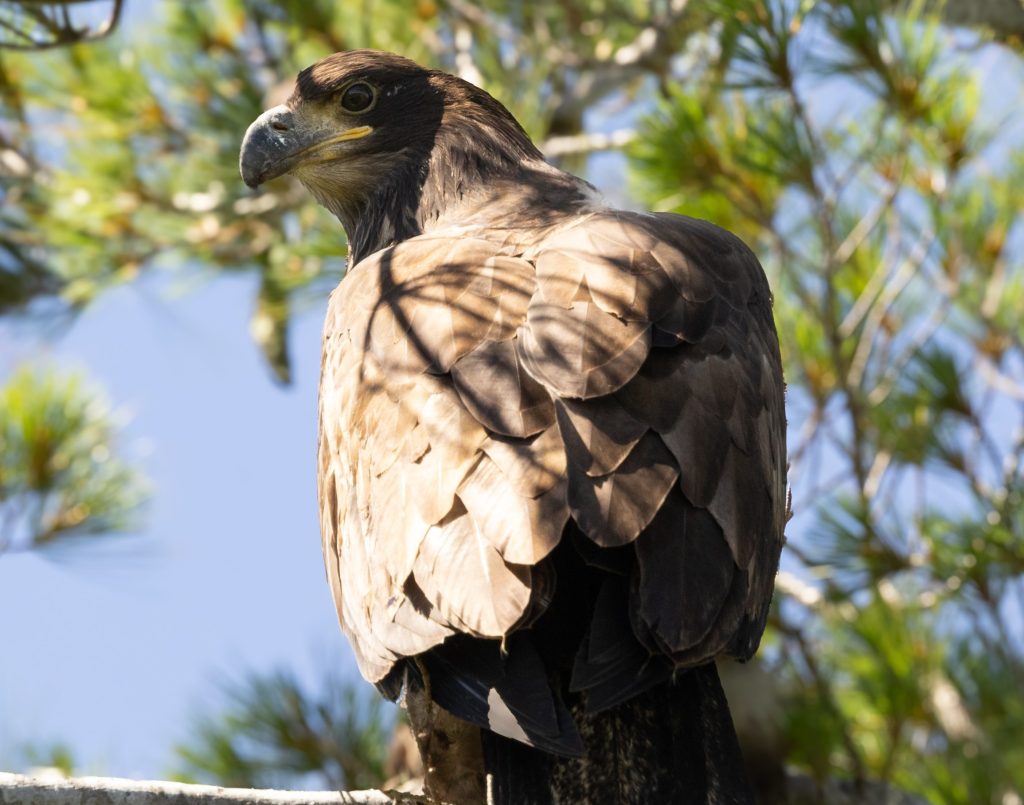
Apparently, a pair of bald eagles feel the same way. When I was there in April for niece Emma’s track meet, Jen showed me their nest constructed in the tallest remaining fir tree in the far northwest corner of the lot. Adhering to the trope persona of a retiree, I took up bird photography a few years ago and— also true to stereotype— therefore automatically consider myself an expert on all things aviary. It surprised me— based on my almost non-existent knowledge of bald eagles— that they would choose to nest in rural Iowa— nearly two miles from the nearest “open water”. [I put “open water” in quotes, because the water to which I’m referring is actually a shallow farm creek north of the house that can almost be stepped across in the heat of the summer.]
Yet, there they were soaring over the April fields north of the yard. As I watched them majestically perched in what was left of the grove–probably scaring the hell out of all the other neighborhood birds and bunnies, I was reminded of an old “Far Side” cartoon panel from the 80’s showing a group of perched raptors wearing sunglasses and listening casually to headphones. The caption read, “Birds of prey know they’re cool.”
I returned to Benton County Heaven in June for another visit and to pick up my sister on our way to my 40th high school class reunion held in our hometown on the other side of the state. She’s three years younger than me and was excited about “going to a party with senior boys.” My wife wasn’t as enthused and declined the opportunity.
While I didn’t spot the eagle parents, there were two highly visible eaglets testing their wings from tree to tree. They looked healthy and eager to take on the world.
++++++++++++++++
High School reunions in my hometown of Jefferson are always held the second weekend in June, coinciding with the community’s Bell Tower Festival, named for the town’s premier tourist attraction, the Mahanay Bell Tower. Jen and I arrived shortly after 11:00 a.m. Saturday in a steady drizzle. She’d been back 3 years ago for her own reunion, but this was my first return since our parents divorced and left town over 30 years ago. After driving by the new high school (which we were unsuccessful in illegally entering) and touring past old friends’ homes, we grabbed lunch in a newly opened pub east of the courthouse on the town square.
The space the pub inhabited used to be a family-owned hardware store where I worked for two summers during college. It was a True-Value franchise, owned and operated by a young couple. They were kind to me, even though I was (and am to this day) hardware-incompetent. The store had a dizzying array of inventory. My first customer of the morning might be a painter needing 6 gallons of a particularly tinted interior paint. The next might be an elderly woman shopping for a place setting from her grand-daughter’s wedding registry, needing it (very) neatly gift-wrapped. It was my first opportunity to practice adult interaction. Today, I wouldn’t consider my customer base a diverse population, but the experience forced me outside my comfort level and the opportunity to interact with different people expanded my horizons.
My ‘smashburger’ at the pub was delicious, and after lunch we visited a small book and gift shop next door and I bought Lauren Groff’s latest collection of short stories. I thought about how cool it would have been to have a place like that to hang out in over summer breaks in college. I also noticed something else that had been missing from Jefferson in the late 1980’s— black and brown people were present in the shops and in the streets enjoying the festival with their families.
There were other additions to the town square. Each alley contained one or more vibrant murals [ https://www.experiencejeffersoniowa.com/directory/jefferson-murals] featuring abstract objects as well as local scenery.
After lunch we took the elevator to the top of the Tower and admired the agrarian landscape. Closer to the square, we could see more murals that had also been painted on local rooftops.
Next, we attended an “Open House” at our old Middle School building, which a real estate developer is in the process of converting into apartment housing. The familiar wide corridors with industrial/academic tile floors and lockers remaining along the walls (covered in plastic sheeting), were familiar and somehow comforting. The open doors, however, led to modern 3-bedroom apartments, complete with granite kitchen countertops and hardwood floors, in place of our 7th grade social studies classroom and the small space where my mother used to teach art.
Our next stop was a woodworking studio/museum/dinner theater complex that one of Jen’s classmates had opened several years ago. Robby, the proprietor, named it “RvP-1875”. As he led us on a tour of his showroom/production facility, he explained that he and his apprentices use only tools and materials available in the year 1875. He chose that year because it was just before the impact of the industrial revolution converted furniture production from an artisanal endeavor to a mass-production industry. In place of nails and other fasteners, Robbie uses complex 3 and sometimes 4-way hand cut tongue and groove joints and pegged/dowel joinery to fasten the boards that he hand-planes from trees that he cuts down with an axe and handsaw.
Next, Jen arranged for us to “take a peek” inside our old house . Our hosts, whom have owned the house now twice as long as our family, provided much more than a peek. Rather, they opened their home to a room-by-room tour (including basement and attic), complete with warm oatmeal chocolate chip cookies. The beautiful woodwork and leaded glass cabinets in the dining room were just as I remembered. The rest of the house was frankly in much better condition than when we left. It’s current owners, who’ve raised their children into adulthood in the house are wonderful people and clearly share our love for the place.
That evening, we attended my reunion dinner. My classmate-hosts, Sean and Angie, haven’t lived in Jefferson for over 30 years but have been designated decennial organizer/hosts based on the availability of a spacious workshop in the backyard of Sean’s parents’ home on the edge of town. It was well-attended with delicious catered bar b que. I enjoyed every minute of it and my only regret is I didn’t take the time to talk to everyone.
+++++++++++++++++
On my drive home from Iowa I thought a lot about change. In my previous life as an mid-level organizational leader, I was continually reminded that change is both required to improve, but also extremely hard to endure. Change almost inevitably makes most people uncomfortable, and often that discomfort manifests in fear and anger.
We’re living through a period of intense and rapid change and predictably it’s making many of us extremely uncomfortable. From college football to artificial intelligence, you don’t have to look very far, or wait too long, to hear someone bemoaning change— and their perception that it is for the worse.
Leaders often don’t help themselves when their organizations encounter a change event. Many don’t appreciate the degree of disruption because they don’t take the time, or make the effort, to understand or empathize with the positions of the people they lead. Others lack the communication skills or patience to clearly articulate a vision of what life will look like on the other side of the “Change Valley.”
The theme of the weekend for me was that change, despite its inevitably painful disruption, can be positive. The Benton County farm operation I remember from my childhood is gone. I have extremely fond memories of that place and the childhood with which I associate it. In its place is a much different, better-smelling, landscape where my nieces and young eagles are thriving.
Similarly, Jefferson looks a lot different than it did in 1985. Forward-thinking leaders were willing to let go of the past and embrace diversity in both the economy and the population. As a result, the community is thriving and new opportunities are presenting themselves.
It’s easy to see the positive results of change when you drop-in for occasional snapshots. My sister, and longtime Jefferson residents, can undoubtedly point out that a lot of pain has to be endured during the disruption period. It’s important not to minimize any of that— especially if you’re trying to lead an organization through a period of change. However, it’s also important to understand that on the other side of that disruption, an improved state often awaits.


Leave a Reply