Early in my leadership journey, I was asked to lead a newly formed group in a joint venture that Caterpillar operated with Mitsubishi Heavy Industries in Japan. I was really excited. It was my first opportunity to lead a large team and be a “leader of leaders.” The job was in a manufacturing plant in Japan and while I had a lot of respect for the organization and its leadership, I was also being coached by some of my Caterpillar mentors that the joint venture needed a lot of help when it came to the function I was being asked to establish and lead. I had also recently completed my MBA and I was eager to put much of the leadership theory that seemed so compelling in the classroom to work in an actual real application.
My new boss was an excellent leader and a real expert in manufacturing named Shouichi Hirano. I had previously met Hirano-san, but hadn’t worked very extensively with him, and I was eager to make a good impression in our first meeting. So, I spent hours in preparation. I obtained and analyzed data about the joint venture, its product lines and key markets. Based on that data and the coaching I received from Caterpillar counterparts (most of whom had never worked in Japan) I put together a strategic plan for my new organization with key performance indicators and targets. I’d put a lot of thought into the governance model I wanted to use and I created a powerpoint presentation with very detailed descriptions of the meetings I intended to hold and the performance milestones I wanted the group to achieve in my first 90 days.

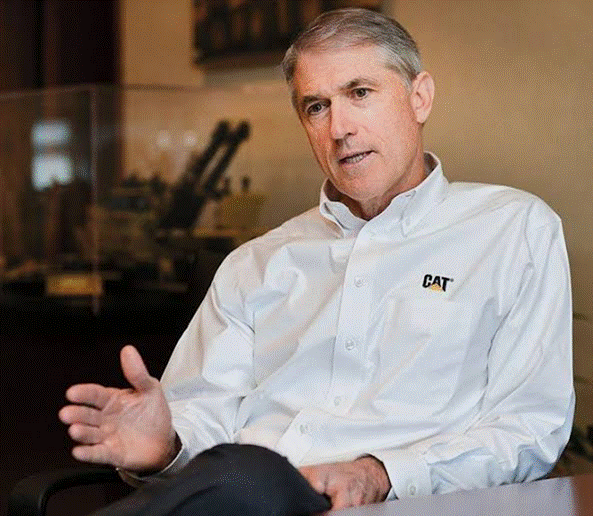
Shin Caterpillar Mitsubishi CEO, Shouichi Hirano
I marched into Hirano-san’s large office for that first meeting feeling well-prepared and unusually confident. After his Administrative Assistant had served both of us tea, I pulled out my thick three ring binder (I had heard he preferred paper to digital slides) and started flipping through the pages excitedly explaining my plan for how I was going to establish and lead this new function.
After a few minutes of politely nodding as I chattered on, Hirano-san’s expression began to change and I could sense a combination of confusion and maybe a subtle hint of…irritation? His English was adequate, but not great, and I thought maybe I was speaking too fast, so I paused and asked if he had a question. He stared at his teacup for an uncomfortably long period of time while I supposed he worked on the appropriate English formulation of his question.
Finally, he said softly and haltingly, “Thompson-san, …you need to … listen.”
I swallowed, nodded and leaned toward him, trying to demonstrate my commitment to active listening and genuine interest in whatever wisdom he was about to dispense.
Again, there was an extended (and awkward!) pause and it became clear he didn’t really have any other comment.
Finally, he started chuckling, sensing my confusion and understanding that I had misinterpreted his very simple and direct statement.
He then added, “You are very bright and I think you will do well in this new job, but before you put into place any metrics or targets or governance systems, you need to sit down with the people in this organization who’ve been here awhile and understand how things work. Many of them are very bright too, and until you understand what they do and how they do it, you’ll be wasting your time trying to lead them.”
It was the single most impactful leadership advice I’d ever received and I’ve tried (and occasionally failed) to heed it ever since. It’s very easy for leaders to become convinced that because of their salary grade, degrees, certifications, previous experience or just plain innate superior intelligence, they somehow own the only truth in the room on a given topic. Leaders falling into this trap see themselves as a fount of wisdom and view their role as primarily to direct and instruct. Many times, leaders who adopt this philosophy stay inside their offices for days at a time churning away on advice-filled emails and reading books they purchased in an airport bookshop by the latest management guru. They nearly always fail.
I obviously think there’s a better mindset for a leader of a problem-solving organization, and I learned it from watching leaders like Hirano-san. A problem-solving leader is someone who understands there are very few problems they can solve on their own. They see their primary role as assembling diverse teams and helping them by asking the right questions, identifying problems and helping remove obstacles in their team’s problem-solving path.
To function in this way, though, the leader needs to understand as much as possible about the operations of the organization. (I’ll refer to this as “the business” even though it the concept is equally applicable in a non-profit organization.) The best way to acquire this knowledge, as Hirano-san knew, is to interact as much as possible with the people engaged in the business. The ideal way to do this, is to physically go to where they’re working[1]— whether that’s a production floor, row of cubicles or a classroom. When good leaders “go to the work”, they mostly observe, but, when the context is appropriate, they don’t hesitate to ask questions to make sure they understand what’s going on in the organization and the problems and challenges that team members are facing. This philosophy is sometimes called “Go and See Management.[2]”
As my friend and mentor Ed Rapp observes, “the higher you move up the organization, the greater the number of filters between you and the truth.”[3] Hopefully, you as a leader, will build a culture where people feel empowered to bring forward problems. However, as we’ve previously noted, doing so is contrary to human nature and while most members of your organization probably won’t actively keep important information from you, it could very well be that your position as a leader— especially if you and your team work remotely— can keep you from seeing an accurate view of what’s going on in your organization. Building relationships with your team members helps remove these filters, and one of the best ways I know to build those relationships and to show team members that you care about their work is to be as present as possible.
Here are some additional benefits the “Go and See” approach offers:
1) Although often not as big a factor for “knowledge workers”, ensuring workplace safety is arguably the biggest responsibility a leader has. The best way to assess and confirm that workers have a safe environment (mentally and physically) in which to work is to be present with them in that space as much as possible.
2) As mentioned above, watching and interacting with team members is often the most effective way to learn about the organization and its operations.
3) Most team members take the physical presence of their leader as a manifestation of his or her interest and concern. Nothing is as deflating as working for a boss who doesn’t know you or understand your work. Being present and asking questions about their work also conveys to team members that they have a leader who cares about their ideas and empowers them to drive improvement.
Some team members—especially those unaccustomed to having a leader present “on the floor” may at first be suspicious and uncomfortable with having a leader present. To make team members comfortable, it’s helpful to be very open with them about why you as a leader are there— to learn and help– and ensure you are earning their trust.
“I don’t know enough about our operations and I’m here to learn more about what you’re doing so I can be more effective in helping you find and fix problems” is a great way to break the ice, learn and build trust.
Sometimes this approach makes leaders themselves uncomfortable— especially if they gravitate toward the “fount of wisdom” approach. I occasionally see leaders failing to ask questions because they feel that doing so will make them look uninformed or unintelligent. This is almost always a mistake. Of course, a leader asking certain questions may occasionally raise eyebrows and cause some team members to wonder, “I can’t believe they didn’t already know that!” However, asking questions (even if the answer may be obvious to others) is the best way to learn. Also, the question is rarely as silly as you might think it is. I have always followed the rule, “If I’m wondering about this question, then others in the room probably are too, so I might as well ask it.”
Ultimately, your team members will have much more respect for a humble leader who is open about their desire to learn and help, than for a leader who isn’t familiar enough with the work, tries to fake their way along and eventually makes decisions that demonstrates their ignorance and creates waste.
Many of you will enter knowledge-work jobs where you may not be physically in the same space as your team members most days. Or, occasionally, leaders interacting with people at the worksite can be physically dangerous or unduly distracting. “Going to the work” in these cases is obviously a bit different than walking a factory floor or observing a classroom, but it can still be done. Here are some tips:
- Create an ongoing process[4] and preschedule your “visits”. In a physical work environment, leaders can often just show up in the location where the team is operating. This may or may not be a good idea, depending on the nature of the work and the team dynamics, but you don’t want these “visits” to be misinterpreted as “gotcha” efforts to confirm whether people are working at certain points in the day. Therefore, I think it’s best to explain to whomever you want to visit with that you are contacting them to learn more about their work and set the meeting on their calendar with plenty of advance notice— and perhaps on a recurring basis. These sessions are usually simplest when conducted 1:1 or with a small team.
- Ask to “ride-along.” When technology allows, ask the person to simply continue doing whatever tasks they would normally be doing and sharing their screen with you so they can explain the various steps they are undertaking in real time. For this to work, screen-sharing, virtual whiteboard and camera technology can be helpful.
- If a “ride-along” isn’t practical, then ask the team member to describe what they would “typically” be working on during this point in the day/week/month and how they would do it.
Whether in person or remote, these “going to the work” sessions can be awkward, especially if the leader or team member isn’t accustomed to them. Here are some helpful questions to help avoid the cringey gaps in discussion:
- What’s the most important thing you’re working on these days?
- What are some of the key processes you use to accomplish X?
- Why do you do it that way?
- How were you trained in those processes, and do you have standard work documentation available? [5]
- What problem at work has you most worried right now?
- What do you think is the biggest risk to our customer satisfaction arising out of the work done in this group?[6]
- How can I help?[7]
Retired Caterpillar Group President, Ed Rapp
As we get busier as leaders, “going to the work” is an easy thing to crowd out of our calendars. I remember former Caterpillar Group President Ed Rapp as an executive who always seemed to be entrusted with a lot of responsibility. His list of leadership accomplishments included turning around one of Caterpillar’s lowest performing product divisions, as well as leading Caterpillar through the Great Financial Crisis of 2009 as its CFO. Throughout his career, it seemed Ed was always rewarded/burdened with challenging assignments because Caterpillar CEO’s and Directors knew he was the best person available to meet and overcome those challenges. During his entire tenure, though, he always managed to maintain relationships at all levels of the organization. Even after being promoted to the Group President level, Ed would work one day each quarter side by side with assembly workers on the production line at one of Catepillar’s manufacturing facilities[8] Ed understands the importance of “going to the work” and if he could find time for it, anyone can.
One final thought— sometimes leaders need to drive change that isn’t universally accepted or supported by members of the organization. In other words, “Respecting Those Closest to the Work” doesn’t mean ensuring that every decision you make is popular with the entire organization. At the end of the day, leaders of highly functioning organizations need to adopt solutions to problems that not everyone in the organization will agree with. Going back to my example in Japan— while in that job, I ultimately decided to discontinue several products that the joint venture had manufactured for many years in order to improve profitability and the sustainability of the business. Those were difficult decisions, and I didn’t take them until I’d spent a significant amount of time talking to members of the organization and worked with a team to ensure that we understood the competitive market, customer requirements and had identified and assessed an array of alternative countermeasures. Ultimately, while people were disappointed in some of those decisions, most knew that I understood their positions and the fundamentals of the business they were operating. While they may have disagreed with me, that knowledge made execution of the solution much simpler and easier to accept.
Ed made much tougher and broader-impact decisions leading Caterpillar’s Building Construction Products Division and as CFO during perhaps the most challenging macro-economic environment in the company’s history. Not everyone loved the idea of closing plants or shrinking global product lines, but we all knew that Ed had taken the time to gather information and understand input from different levels of the organization before finalizing those steps and that gave us greater confidence in both him and the changes he was driving.
[1]. This physical aspect of going to the work is obviously complicated in a remote work environment. A bit more on that later.
[2]. The term, like many continuous improvement concepts, originated in Japan, and Hirano-san knew it by its original Japanese phrase “Genchi Gembutsu”.
[3]. Rapp and Jain, p. 17.
[4]. Hopefully, this will remind you of the concept of “normalizing” the practice of employees bringing forth problems discussed I the previous chapter in the context of incentivizing members to find and bring forth problems. Same concept — making something normal that may at first feel uncomfortable.
[5]. If not, this is probably a leadership failure, not an employee failure. More on this in the next section.
[6]. This is also an excellent way to embed a customer-focus culture, as we’ll discuss later in Part 3.
[7]. The best for last.
[8]. Rapp and Jain, p. 65
 Iowa Diasporan
Leave a comment