Introduction
Ok, so we’ve been introduced to “The Universe of Opportunities” and embraced the “Rule of Perpetual Frustration”. In so doing, we now understand and accept that there will always be more worthy problems to solve than time and energy available to solve them. We’ve also discussed some high-level filters to narrow down the Universe of Opportunities— specifically, biasing toward what we can most influence and the Pareto (80/20) Principle.
Great leaders tend to have a disciplined approach to provide those around them with what Ed Rapp calls “an unequivocal clarity of direction focused on the few things that will make the biggest difference”.[1] In his book, The Flywheel of Life and Leadership, Ed talks about the importance of every leader deploying an Operating Model to establish a culture of how to get things done. Developing and deploying an Operating Model to leverage your organization’s business model is beyond the scope of this course. However, as Ed points out, one of the simplest forms of Operating Models is “management by objectives”, which can be very useful in helping to prioritize the Universe of Opportunities. That’s where we’ll focus our attention in this part of the course.
There are many effective Operating Models that leaders and organizations leverage. “Management by Objectives” is just one, but it’s a very common and impactful one. We’ll spend a bit of time understanding it and how it can help leaders and individual contributors organize their time and select among the “Universe of Opportunities”. To do that, let’s begin thinking about an organizational journey— similar to Dorothy and her friends in “The Wizard of Oz”.
What are the key aspects of any journey?
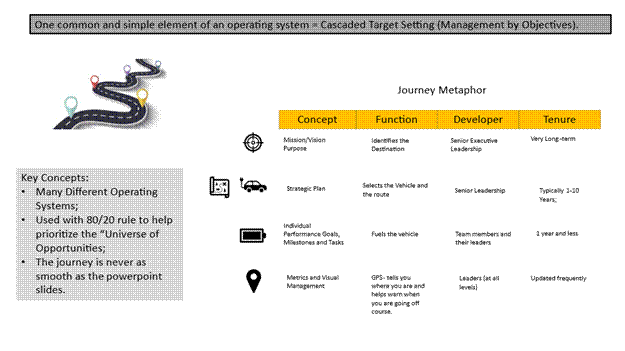
First, you need a Destination. Early in the story, after mysteriously landing in a strange location, Dorothy recognizes that she needs to speak to the Wizard, and therefore must somehow travel to The Emerald City where he resides. The Emerald City, then, is her destination.
Second, you need a course (the route kind, not the college kind). In the Wizard of Oz, Dorothy’s course was The Yellow Brick Road. When Dorothy and her friends strayed from the Yellow Brick Road or ran into other obstacles that kept them from reaching the Wizard’s Palace in the Emerald City, it created problems (opportunities) that needed to be solved.
The members of any well-run organization need to understand what they are trying to achieve. For purposes of our analogy, this becomes the Destination. Every employee should be able to describe that organization’s version of the “Emerald City.” Challenges that stand between any given state and achieving that Destination begin inevitably to appear as problems that need to be solved and opportunities for improvement.
Articulating and communicating the destination, however, is not enough. A well-run organization also needs a strategy (or strategic plan) that serves as both a map, and a vehicle, for reaching that destination.
Inevitably, our organizational vehicles at some point depart from the intended course. These inevitable departures represent another set of problems that leaders and the other members of the organization must solve. These, of course, are not the only problems or opportunities for improvement that leaders are confronted with in their day-to-day lives, but they make up an important constellation in the Universe of Opportunities.
Once the map and vehicle are selected through the strategic plan, the vehicle must be powered. In the Management by Objectives Operating system, that power comes from individual performance goals that are further broken down into milestone tasks and are constructed to align with the strategy. Every individual in an organization working on measurable performance goals that help accomplish the strategic objectives can be an extremely efficient fuel in powering progress toward the organization’s destination.
In the sections that follow, we’ll break down Management by Objectives a bit further and extend the journey analogy to use metric tracking and visual management as more granular map-reading tools that can help us spot and prioritize problems. We’ll conclude this part of the course by discussing other insights that can assist in opportunity selection:
- Biasing toward root cause issues;
- Understanding urgent vs. Important;
- Ensuring that two categories of problems fly to the top of any prioritization list:
- Health and Relationships; and
- Compliance
A. Defining the Journey: Management by Objectives, Metric Tracking and Visual Management
We learned from the 80/20 Principle that solving the problems represented by only 20% of your Universe of Opportunities will create most of the value. But, value toward what?
Imagine I give you a list of Pella streets. Now, I ask you which of those streets I should drive on. The 80/20 rule may help you understand that a limited number of those streets will be helpful to me, but there’s a big piece of information missing to help me decide on which street to drive.
Where am I going and what am I trying to get done?
In other words, in order to effectively deploy the 80/20 principle as a selection filter for the Universe of Opportunities, members of an organization need to understand what the key outcomes are that they are trying to achieve.
Where are we going and what are we trying to do?
The answer to this simple, but powerful, question is hugely important for leaders to understand and to clearly communicate. This is the organization’s Destination, we talked about in introduction above. An organization that is aligned on its Destination will be much more focused and effective in its problem-solving than one that is not. Unfortunately, answering that apparently simple question—where are we going and what are we trying to do? –at least in a level of detail that is helpful to individual contributors– can be deceptively complex.
Management by Objectives (or Cascaded Target-Setting) is a method for simplifying the process of aligning an organization and clarifying the Destination, down to the individual contributor level. There are several ways this can be done, but the following is a common cascade:
- Purpose Statement (Organization)
- Mission Statement (Organization) (sometimes combined with the purpose)
- Vision Statement (Organization)
- Strategic Plan (Organization— although may be cascaded to sub-units in large orgs)
- Annual Goals (Individual)
- Quarterly/Monthly/Weekly Glidepath Milestones (Individual)
- Weekly/Daily Tasks (Individual)
A detailed “How-to” discussion on each of these elements is beyond the scope of this course and not necessary to understand their value in filtering the Universe of Opportunities. However, it’s important to understand the substance of each element and therefore we’ll spend a bit of time unpacking these concepts.
For any given time period, it is much easier to filter the Universe of Opportunities (using the 80/20 Principle), when you are part of an organization that has aligned and cascaded targets answering the critical question of “where are we going and what are we trying to achieve?”

1. Setting the Ultimate Destination: Purpose, Mission and Vision
The top part of the cascade is constructed at the highest level of the organization and answers the broadest set of questions. Often, it begins with a Statement of Purpose, which answers the “why question.” A well-constructed purpose statement defines why the organization exists, and in so-doing often explains the value that the organization provides to key stakeholders, such as customers. It may also touch on why the organization is better equipped to fulfill that purpose than other competing organizations.
Sometimes, you will see Statements of Purpose slightly differently constructed in a more action-oriented manner and described as Statements of Mission (or Mission Statements). Usually, a well-constructed Mission Statement will answer the same set of questions described in the Statement of Purpose, but will be phrased more in terms of actions and objectives. Occasionally, you will see organizations articulate both a Statement of Purpose and a Mission Statement.
Another broad statement you will often see constructed at the highest level of an organization is a “Vision Statement.” This is often articulated as a description of what the organization, and/or its larger ecosphere[2], would look like if the Mission and/or Purpose were fulfilled. This can be a helpful tool in making the Mission and/or Vision statements more concrete and easily understood by employees and other stakeholders.
These overarching elements at the top of the cascade share two important, and somewhat related qualities:
1) They are aspirational and unlikely to ever be actually achieved, at least in the short term. By their nature, these elements of the cascade should illustrate significant distance between the state they are describing and the “as-is” condition. This is important because a key purpose of these statements is to motivate employees and stakeholders to close the gap. If these statements describe the status quo, there’s nothing to work toward.
2) Unlike aspects we’ll cover lower down in the cascade, these statements function to set long-term direction and ensure alignment of shorter-term strategies. They should, therefore, be enduring statements that are not significantly altered in the short term. Highly functioning organizations typically do not make significant changes to their Mission/Purpose/Vision statements unless there’s a disruption in their ecospheres that dictates a new organizational direction.
2. Drawing the Map and Picking the Vehicle: The Strategic Plan
Many organizations tie their Strategic Plan to a 12-month calendar period, but the concepts in this section may cover a longer or shorter period of time. For our purposes, a well-constructed strategy, whether annual or otherwise, should take the Purpose/Mission/Vision statements and translate them into something more time-bound and actionable for the business and relatable to daily work of employees. Successful strategies often include the following aspects:
- They include a time-bound definition of winning, often articulated as achievement of a successful level of a metric by a specific date. (a target)
- They are general enough that all levels of the organization can link their individual performance to successful achievement of the strategy. In other words, they should offer line-of-sight from any member’s daily activity.
- They often define “critical success factors” or “key enablers” that represent aspects of the organization’s operations, or perhaps sub-metrics, where significant improvement or focus must occur for the definition of winning to be achieved.
In large organizations, the Strategy itself may be cascaded, within the organization and/or over differing time periods. Organizationally, for example, the “head office” of a global widget manufacturer (let’s call them ACME Widget) may articulate a strategy to grow sales 30% globally over 5 years by focusing on growing its share with existing customers. The leadership of subsidiary divisions and/or geographical units takes that work and constructs a strategy with similar elements that are applicable to its particular operations. So the leadership team of ACME AP, representing Acme’s Asia-Pacific businesses may develop its own strategic plan to grow its business a proportional amount and identifying particular customers in the region to whom it must increase sales over the next five years.
Similarly, organizations may cascade strategies over differing time periods. So, Acme Widget may define annual glide path targets and specific strategic milestones that need to occur in the next 12 months to put it on a pace to achieve the 5 year strategic goals of doubling sales. Perhaps, targeting an 8% increase in year one (under the theory that some advance work will be necessary to achieve faster growth; and focusing on releasing a new product that will fill an unmet need for existing customers to accelerate growth in subsequent years and achieve the 50% target in year 5.
3. Powering the Vehicle: Individual Performance Goals, Milestones and Tasks
Broad statements of enterprise purpose and mission are a good place to start, and the strategic plan takes a step toward making those statements more actionable. To complete the cascaded target-setting process, though, every member of the organization should have individual objectives that are aligned with the broader organizational components of the cascade. These objectives, working together with the 80/20 Principle, can then serve as an important prioritization tool to help individuals and leaders effectively filter the Universe of Opportunities and determine how to most constructively deploy their time.
Individual Performance Goals
Individual Goals should be “SMART”.
“SMART” is an acronym that helps in the construction of well-developed individual performance goals.[3] Effective individual goals should be
- Specific: Well defined, clear and unambiguous. This is a key to any written material, regardless of context.
- Measurable: With specific criteria that measures the individual’s progress toward the accomplishment of the goal. There should be no room for debate on whether a goal has been accomplished or not.
- Achievable: Attainable and not impossible to achieve. Few things are more de-motivating than pursuing a goal that can’t be achieved.
- Relevant: The goal should be aligned to the organization’s strategy.
- Timely: with a clearly defined timeline, including a starting date and target accomplishment date. Deadlines tend to be highly motivational.
Glidepath Milestones
Members of highly functioning organizations are often required to draft individual SMART goals that cover an extended period— often a year. However, to help employees in making day-to-day progress against these goals— and to assist in the filtering of the Universe of Opportunities— I highly recommend developing a next step that breaks SMART goals down into “Glidepath Milestones”. This practice is particularly helpful for large-scope performance goals (in either timeframe or complexity), the execution of which can sometimes be overwhelming.
There’s no rocket-science involved in developing glidepath milestones, but it requires discipline. I find the easiest way to build the habit is to begin every year setting aside appropriate time on my calendar for planning— including updating periodic milestones. Once that’s done, the following laughably simple process can be modified to set glidepath milestones on a quarterly, monthly, and/or even weekly basis.
- Review the SMART Goal.
- Ask, to accomplish this goal by the due date stated within the goal, what do I need to have achieved in the next 90/30/7 days. (Borrowing from “SMART” methodology, the milestone(s) should be specific, measurable and achieveable.)
- Write it down! (more on potential documentation format later)
Tasks
The final— and most specific— step in the Cascaded Target-setting process is to document daily tasks. Again, I highly recommend that leaders reserve time on their calendars daily for this. Then, the daily process simply replicates the Glidepath Milestone methodology above but narrows the scope down to another level of immediacy — most likely weekly or daily. So, to develop your task list:
- Review the most immediate Glidepath Milestone(s);
- Ask, to accomplish this milestone by the date defined, what do I need to achieve (this week) (today)?
- Write it down!
One final thought here, before moving forward to a deeper discussion on intentional planning and documentation. High achieving people inevitably tend to set more (and larger) milestones than they can actually achieve. That’s why “achieveable” is an important part of the SMART acronym, and— and I hope this sounds familiar— why the 80/20 principle is so powerful. As you are developing both milestones and tasks, try to focus on identifying the milestones/tasks that you can accomplish (today/this week) which will have the greatest impact on my ability to achieve the milestone/goal.
4. Staying on Course: Lead and Lag Measures and Visual Management
In addition to the definition of winning, a good strategic plan should include some form of “critical success factors” or key enablers that, if accomplished, should put the organization on track for meeting the targets set out in the definition of winning. [Acme Widget, for example, identified increasing its share with existing customers as a key enabler.] A properly constructed target-setting cascade then translates these targets down through various levels of the organization ensuring that everyone has line of sight between their daily work and achievement of the strategic targets.
Often, progress toward these strategic targets is tracked through a combination of [4]lag and lead measures and communicated through dashboards or other elements of visual management.
- Lag Measures tell an organization how well they’ve performed during a preceding period. Think total sales for ACME Widget Company, for example. Or, from a personal fitness standpoint, your weight. Both of these are indicators that reflect activity/performance in the past. Often, a company’s strategic plan will identify a lag measure target as the “Definition of Winning”. Let’s imagine that ACME Widget develops a strategic plan targeting improving sales in the current year from $8m to $10m.
- Lead Measures are often designed to measure the status of activities that should drive improvement in an identified Lag Measure. For example, if ACME Widget wants to increase Widget sales this year, it may identify increasing the number of sales calls that its sales force makes as a key enabler in the strategy. It will then track the number of sales calls per week as a Lead Measure and set a target for each salesperson to make at least 15 such calls per week. (Following the theory that more sales calls will result in higher total sales) Similarly, a person who has set a personal fitness goal of losing 5 pounds in the year (the Lag Measure), may identify cardio-intensive exercise as a key enabler of that strategy and begin tracking the minutes of cardio-intensive exercise per week as the Lead Measure, targeting 120 minutes per week.
- Visual Management (sometimes referred to as dashboards or scoreboards) is necessary to track progress on both Lag Measure Targets and Lead Measure Targets. Well-constructed Visual Management may take many different forms, but a successful dashboard will allow a viewer to quickly determine (1) the level of performance being targeted (in the above ACME example, you can imagine a clearly identified target of 10m); (2) the level of performance being currently achieved (in the dashboards below, it appears that ACME is at a little over $2m in sales through March; and 3) the difference (negative or positive) between the target and actual performance (ACME appears slightly behind target through March).

Well-constructed Visual Management is an important organizational tool in the following ways:
- Most importantly, for this course, Visual Management provides an important tool for problem-spotting. A well-constructed dashboard will tell a leader (or individual contributor) if an organization, or individual, is underperforming on a key lag/lead measure. If that metric is important enough to be the subject of a dashboard—either operational or strategic, then that underperformance represents a problem in the Universe of Opportunities that should pass through the filter and be further examined for prioritization.
- It is an excellent communication tool to ensure that an organization understands key elements of the strategic plan and how the company is performing.
- Finally, Visual Management is an important motivator. As the authors of the Four Disciplines of Execution observe, try watching a group of kids (or adults) playing basketball in a gym or on a playground. Notice the change in intensity when they start keeping score.
Let’s imagine that ACME’s mission is to be the world’s largest provider of widgets. That becomes the company’s destination. Its leadership develops a strategic plan that defines success as increasing annual sales from 8m to 10m this year. That strategic plan is the vehicle for achieving the destination. Deborah, a Sales Associate for Acme sets her performance goal as achieving $100,000 in sales this year and a monthly milestone of making 12 sales calls per month. This is the fuel that powers the strategy. Deborah is likely to prioritize her time around solving problems that keep her from making sales calls. The Visual Management dashboard above can serve as a kind of GPS to help Deborah and her leaders determine when the group is coming off course at the earliest point possible and to identify problems that need to be solved in order to get back on course.
B. The Value of Cascaded Target-Setting at Different Points in Time
Having an organizational Destination, defined and refined through cascaded target-setting, provides leaders and individual contributors a key filter to help sort through which problems represented in the Universe of Opportunities are:
- Worth expending time and energy on immediately;
- Worth addressing eventually; and, perhaps
- Not worth pursuing at all.
Here’s a simple two-question filter that can assist in this regard:
- Will spending time on this problem help me achieve my individual performance goals or make progress toward a glidepath milestone?
- Will spending time on this problem help my organization achieve a key target defined in its strategy?
The results of the targeted cascade can also help a leader identify and solve key problems at two separate points in time:
- The beginning of the period defined in strategy and/or performance goal scope, offers an opportune time to:
- Ask what problems must I and/or my organization solve in order to achieve my performance goal or the organization’s lag/lead metric target?
- Define appropriate Glidepath milestones and tasks to document in order to solve that problem;
- Deploy the Execution toolkit described in Part 2 of this course;
- During the period defined in the strategy and/or performance goals, a good leader should be continually and intentionally monitoring visual management tools and engaging her team, asking:
- Am I (or my organization) on track to achieve our Lag/Lead targets defined in the strategy? If not, what problems must be solved to get us back on track?
- What glidepath milestones and tasks must I document to solve this problem?
As you approach these questions and undertake these steps, don’t forget about the 80/20 principle. Think deeply about what steps will provide the most leverage in helping solve the problem. Two additional tools described in the next section should be helpful in this regard.
Reflection Questions
- Check out the website of an organization that you are familiar with (could be a business or non-profit). Do they list a mission/purpose/vision statement?
- If so, do you think it’s effective in using as a basis to build a strategic plan? (Why/why not?)
- Consider your favorite sports team (or maybe one that you have participated on). If you were responsible for their strategic planning,
- What sort of Mission/Vision might you draft for them?
- What would you include in the team’s strategic plan?
- What lag or lead measures might you use to determine progress against that strategic plan and what would be realistic targets for each?
- What are examples of problems that might surface when performance falls short of
C. Additional Insights and Tools for the Filtering Toolkit
I know at this point, everyone is completely enraptured by this course and can’t wait to move on to learn about the execution toolkit. J Not so fast!
There are a few additional insights that I think are critical to the filtering process for any leader trying to prioritize the Universe of Opportunities.
- Certain categories of problems are so universally important that they almost automatically rise to the top. For me, this very short list includes (i) any problem related to personal health and relationships; and (ii) problems that could lead to regulatory or compliance violations.
- It’s also helpful as you are filtering and prioritizing your Universe of Opportunities to ensure that you are getting as close as possible to the “root cause” problem.
- Importance and Urgency aren’t necessarily the same thing and they require different modes of prioritization;
1. Two Priorities that Fly to the Top
We’ve spent a significant amount of time in this Section of the course focusing on using your organization’s strategy and your own personal performance goals to help filter the Universe of Opportunities. However, there are two categories of problems that are much more straightforward in their analysis and should proceed quickly through your selection filter and to the top of the list of things requiring your time and attention.
- Health and Relationships (while these may not appear to be business problems, their existence, if unresolved, will almost certainly suboptimize business results); and
(2) Legal/Compliance. Not paying sufficient attention to these areas is the fastest way I know to destroy value in an organization.
A. Health and Personal Relationships
These are two categories that we normally associate with the “personal” aspect of our lives as opposed to “professional”. I intentionally put those two words in quotations to highlight the point that while we love to compartmentalize aspects of our lives, and in some contexts it’s helpful to do so, at the end of the day we only have one integrated life. Inevitably, there are points in adulthood when certain aspects of our lives transcend whatever compartments that we attempt to construct for them. Health and Relationships are good examples.
It would be easy to dedicate an entire course to the importance of health and relationships and how they add immensely to our capability across multiple dimensions. For a more detailed look at how these dimensions impact leadership capability, and for some practical guidance on how to strengthen them, refer to the supplemental reading from Ed Rapp’s book, The Flywheel of Life and Leadership.
For purposes of our discussions on leading a problem-solving organization, though, I’ll just make some summary points on why problems in this category should rise to the top of your list when you are deciding which problems to spend your time on:
- Health is the more straightforward of the two components of this first high priority category. Anything related to your need for physical and mental wellness is extremely important and should always move toward the top of any list of priorities. Optimal health requires a good diet, regular exercise, sufficient rest and perhaps some element of religious or spiritual practice. When you are making prioritization decisions in filtering the Universe of Opportunities, you do not want to neglect any of these aspects— at least not for an extended period. It may feel indulgent to ensure you are carving out sufficient time for these things, and too often they are among the first to be cut out during times of high stress and when other deadlines are looming. However, failing to meet these needs and being intentional about carving our sufficient time and attention to them over an extended period will hinder your performance as a leader and the value you can contribute to your organization will be significantly compromised.
- Personal Relationships is an easy category for people to understand, although the identity of the most meaningful relationships in one’s life differs from individual to individual and even the same individual may put different people in this category at different points in time. The most important thing to acknowledge here is that like “Health”, maintaining strong relationships with a network of people — whether that be family, friends, teammates or coworkers– is an important part of maintaining a balanced and productive professional life. Without exception, the most successful leaders with whom I’ve interacted over my career are intentional about prioritizing time to ensure those relationships are not neglected over an extended period. Failing to do so will inevitably lead to poor professional performance.
So, why should problems in these areas fly to the top of your Universe of Opportunities? I’m not necessarily saying they should in every case and during every week in one’s life. A lot of this comes down to your own personal values. However, I’ve seen too many people not sufficiently prioritize these aspects of their lives and have that decision (conscious or not) rebound against them professionally. Simply put, while we would sometimes love to separately compartmentalize personal and professional aspects of our lives, the bottom line is that if things aren’t going well for us personally, then it is very difficult to be sufficiently focused and optimally effective leader at work. That doesn’t make us weak. It means we’re human.
As former Caterpillar Group President (and maybe the best leader I’ve ever personally known) Ed Rapp notes, “Who do you want making critical decisions in your organization? Someone stressed about their health or relationships at home, or someone with good balance in their life?[5]”
B. Legal and Compliance
The reputation of an organization is perhaps its most valuable asset. Nothing can devalue that asset as quickly or comprehensively as a legal/compliance issue and the associated cost and publicity that comes with it. Unfortunately, there are many examples of once-respected companies who are significantly damaged, or sometimes destroyed, because of insufficient attention to matters related to the conduct of its members. Any problem that lands in your Universe of Opportunities which has a hint of compliance or legal liability associated with it, should rise to the top of the list of things requiring your time and attention.
2. Root Cause Thinking
How a leader defines or frames a problem is important.
An improperly framed problem could lead to unproductive effort and a “solution” that doesn’t add value. Similarly, often our “Universe of Opportunities” is populated by multiple “problems” which, upon closer examination are all symptoms of the same root cause. Many leaders spend inordinate time chasing solutions for separate symptoms while failing to address the root cause. To avoid this waste, it’s important to ensure that when you are considering where to spend your time among the Universe of Opportunities, you ensure you are framing the problem in such a way that you are attacking the root cause and not wasting time by focusing on a symptom that won’t solve the underlying problem.
Think about a doctor whose patient presents with a fever. The doctor could offer acetaminophen to control the fever and make the patient more comfortable, but would she be resolving the root cause of the problem? Probably not. To take a step toward identifying the root cause, the Dr. Would likely ask herself “why is this patient presenting with a fever”. When trying to establish the root cause of a business problem, it’s often necessary to ask why at least five times!
Let’s take the example of a basketball coach (let’s call them Kelly) in their first season with a team (let’s call them the Storm) that was 5-15 the year before. Kelly sat down at the beginning of the year with the Athletic Director and agreed that given the state of the program, 11 wins in this year’s 20 game season would constitute success, and Kelly has therefore drafted the following SMART goal:
“My team will win at least 11 games this season.”
Unfortunately, Kelly’s team has started the current season with a 1-4 record after 5 games. Here’s some data from the first 5 games:
- The team is averaging 85 points per game;
- Ticket revenue is up 10% from last year, but has declined 5% over the course of the 3 home games;
- Opponents are averaging 90 points per game;
- The wrestling team has sold out each of its home matches this year;
- The Storm are giving up an average of 10 points per game as a result of opponents converting offensive rebounds;
- While concessions are down slightly, the sale of popcorn is up 10% year over year;
- The Storm are averaging 45% from three-point range.
- According to a recent on-campus student survey, over 60% of students feel “the Storm” is a stupid nickname.
- The Storm are shooting 52% from the free throw line.
- The Facilities department has had to increase spending to hire an additional temporary staff to help pick up popcorn after games.

After 5 games, as Kelly considers her Universe of Opportunities, she could accurately frame the problem to be solved as:
“My team has not won enough games.”
While this is true, it’s not very actionable in terms of providing Kelly with insights that may lead to glide path milestones or tasks. In other words, in order to come up with actionable insights that can be effectively prioritized and converted to Glide path Milestones, Kelly needs to identify the root cause of the above-stated problem.
A helpful exercise to find the root cause is to frame the problem and then ask “why”.
So, Kelly asks herself, “why hasn’t my team won enough games.” After considering this question for a moment, Kelly re-frames her problem statement,
“My Team is not scoring as many points as the opposition.”
This framing of the problem is a step closer to being actionable. However, under this framing, Kelly might decide an appropriate action plan would be to spend more time practicing 3-pointers in practice? Would that be the best use of their time and energy?
Kelly is not quite at the root cause level yet and needs to ask “why” again. “Why is my team not scoring as many points as the opposition?” This leads to re-framing the problem as,
“We need to schedule teams that aren’t as good.” This may be an accurate problem statement but violates one of the rules we talked about in Part 1.A, in that it’s not something that Kelly or her team can control or influence 5 games into the season and therefore is not a problem that is a good use of Kelly’s time/energy.
Instead, maybe Kelly frames the problem as “We are not scoring enough points.” Back to the 3-pointer solution? Kelly knows from the statistics that the Storm is actually a pretty good 3-point shooting team and therefore extra practice time in this area is unlikely to increase marginal results. Asking why again, yields the following restatement:
“We aren’t successful enough in shooting free throws.”
Here is another apparently actionable insight. Kelly’s first reaction is to re-allocate more time in practice to free-throw shooting. However, while not reflected in the game statistics listed above, Kelly knows that in practice Storm players actually hit over 95% of their free throws.
This time, instead of sitting alone in their office asking why, Kelly brings it up in a team meeting. “Why is it that you guys are so good hitting free throws in practice but not in the game.” Several of Kelly’s players indicate that they feel panicky at the free throw line during the game and have trouble adequately focusing.
Kelly has now gotten to the root cause of the issue and re-frames the problem as,
“We need to find focus when at the free throw line.”
Kelly then sets a task to speak to a resource on campus who can lead the team through a guided meditation practice three times a week to improve focus at the free throw line.
This is a long and perhaps somewhat silly example. The point is many experts estimate that you need to ask “why” anywhere from 5 to 9 times in order to get to an actionable root cause of many problem statements. Failing to get to the root cause when framing problems will result in wasted effort and misallocated time.
3. Urgent vs Important
When deciding how to use their time, and filtering the Universe of Opportunity, many leaders confuse the concepts of urgent versus important.
As Supreme Commander of Allied Forces in Europe during World War II, Dwight Eisenhower had a lot on his plate. He developed a now often-replicated analytical tool for determining how and where to focus his time. It’s a fairly straightforward 2 x 2 matrix shown below.
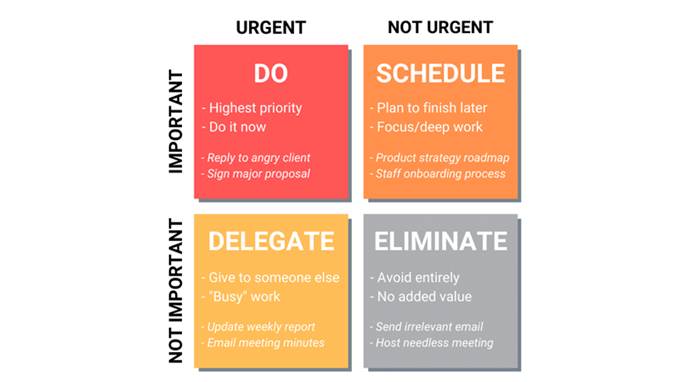
The idea behind the approach is very straightforward— intentionally identify those things that are both time-sensitive and important and give those items your top priority. Take things that are important and not urgent, and ensure you are planning to bring sufficient attention to them at an appropriate future date. Things that are not important but have a tight timeline should be delegated [kind of a problem if you don’t have anyone to delegate to], and things that are neither urgent nor important should be eliminated.
As with all frameworks, it’s messier to apply these concepts than it is to design the matrix. What if you and your boss have a different view on what’s important, for example? Or, as noted in parenthesis, what if you don’t have anyone to delegate to? The answer to both these questions comes down to increasing communication with your boss, and we’ll talk about some helpful strategies for those conversations in the upcoming section on Focus.
A common trap for leaders is they allow so many tasks into the “Do” quadrant, that they never have time to address the Important but not Urgent upper right quadrant. Some tips for overcoming this trap include:
- Reflecting on the Root Cause of repeating urgent tasks to see whether steps can be taken to avoid them recurring in the future;
- Identifying “Important but not Urgent” matters that never seem to get accomplished and attempt to break them down into smaller and more manageable milestones or subtasks with assigned dates for completion.
Reflection Questions
- Has there ever been a time in your life, when your health and/or personal fitness routine wasn’t where you wanted it to be? Did it impact your performance?
- Worldcom, Enron, FTX were all companies that seemed to be getting outsized positive attention in the business press over the last 25 years, yet they all failed suddenly. Why? Can you think of other examples of organizations that suffered from the same phenomenon?
- Can you think of a time when you were addressing a symptom, but not the underlying cause of a problem, or have you seen others do it? What was the result?
- Write down 10 things in your current Universe of Opportunities and sort them into an Eisenhower quadrant. Try this over time and refresh regularly. What sort of tasks are showing up in which quadrants? Are you successful in eliminating the Not Important/Not Urgent? Why or why not? Similarly, does the Important but Not Urgent ever move out of the upper right? Why or why not? Do the same Urgent tasks continue to dominate the upper left quadrant? If so, ask “why” (5 times!)
[1]. Rapp and Jain, The Flywheel of Life and Leadership, p. 73
[2]. For purposes of this discussion, an organization’s “Ecosphere” may be thought of as both the core organization and the other stakeholders and conditions impacting it. Stakeholders might include suppliers, distributors, and the employees. Conditions might include macro-economic factors (are we in a recession?) and/or other external aspects impacting the organization’s health and prospects.
[3]. Google “SMART Goals” and you’ll get everything you ever wanted, plus a lot more, in terms of acronmym definitions and best practices in this area. I found the article linked below from the Corporate Finance Institute an easy and effective read. https://corporatefinanceinstitute.com/resources/management/smart-goal/
[4]. [For a more in-depth understanding of these concepts and how to use them to drive organizational alignment and execution, I highly recommend reading The Four Disciplines of Execution by Chris McChesney, Sean Covey and Jim Huling.]
[5]. Rapp, The Flywheel of Life and Leadership, p. 27-28
 Iowa Diasporan