“But in the case of most people, a deception appears to occur on account of the pleasure involved, for what is not good appears to them as good. They choose the pleasant, then, on the grounds that it is good, and they avoid pain on the grounds that it is bad.” —Aristotle[1]
Ledges State Park is about 30 miles west of where I grew up in Central Iowa. I was there once, as a 10 year-old Cub Scout. I blinked hard and swallowed back tears as I left my mom’s car at the scoutmaster’s house to load into his 70’s style conversion van. My family had just moved to a small town in west central Iowa and I was a new kid. Also, someone said that there were rattlesnakes in the park.
I don’t remember much about the trip other than the park was beautiful, we didn’t see any snakes, and even though all we did was walk the trails, it was a fun day. Somehow, I came back with friends.
That was one of the few trail-hiking experiences in the first 40 years of my life. I don’t know why. I’ve always enjoyed being outside. I guess that outing planted a seed that just took a long time to germinate.
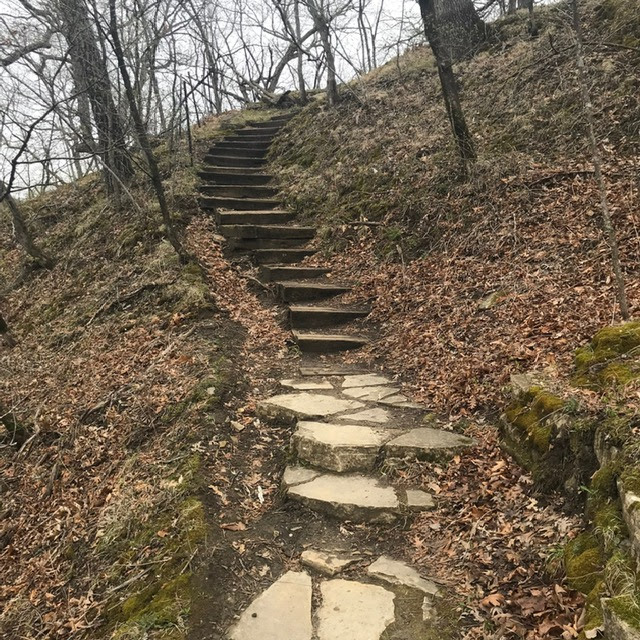
It wasn’t until we relocated to Nashville for the second time, around 10 years ago, that I took up trail-running. “Trail-plodding” is really a more accurate description. Speed isn’t really a part of my process, although the downhill segments of the trail usually ignite a boyish joy that sometimes takes me back to that day at Ledges. The uphill segments are what really got me thinking on this morning’s run.
No one associates “uphill” with boyish joy. Or really anything pleasant. Uphill is hard. Uncomfortable. Unpleasant. And while there’s an occasional view to enjoy, there’s usually no reward waiting at the end of the climb–other than the opportunity to catch your breath—at least in the short term.
There is, however, longer-term benefit. I am told, for example, that running (or even walking) uphill provides exactly the type of high-intensity cardiovascular strain that my daughter pays money for at SoulCycle. Any SoulCycle instructor worth her headband will tell you those uphills increase VO2 max and enable longer healthspan. Less quantifiable, but perhaps even more valuable, though, is the confidence and mental boost that comes from doing hard things. Trail running is a bit of a metaphor in that way. Walking up a short, steep uphill gives me the confidence to try eventually to run it. And then a longer, steeper incline, and on and on.
One of my first lessons in the long-term value in doing hard things was taught to me, like a lot of other important lessons, as an undergraduate at Central College. Like a lot of the most important lessons I learned there, it was taught outside the classroom.
I enjoyed the privilege (and endured the pain) of being a member of the Central College football team in the late 1980’s. One of my teammates was a guy from the small eastern Iowa town of Sabula[2], named Dan Marburger. Dan was a year older than me and we were housemates my junior and his senior year. That was the year I realized what my coaches and many of my teammates had already known for at least two years— I was not good enough to ever see significant playing time . That was not an easy reality to accept. For most of my 20 years or so on the planet, I had built my identity around being an athlete. I loved sports and I loved being on a team. Most of all, though, I loved the high school attention that came from being a good football player, and that was a sensation I was now realizing I would never enjoy again. I remember wondering briefly whether I should continue with the program or quit.
Although we played different positions, Dan had probably gone through a similar phase. I don’t know because despite being friends, we never really talked about it. He was a standout high school athlete who worked incredibly hard but was never going to see the field. It was clear, though, to me and anyone who attended one of our practices, that despite the remote possibility of playing on Saturdays, Dan was fully committed to working as hard as he could during the week to get better but also to improve and inspire everyone playing around him. His example influenced me to change my orientation and to understand that the driving force for me as a member of that team wasn’t to obtain individual attention, but to finish what I started. In the process, maybe I could get a little better and contribute to the improvement of my teammates, but I also worried that quitting this time, might make it easier to quit down the road on something even more significant. I wanted to look back on my football “career” as something I saw through to the end.
Many Iowans probably recognize the name, Dan Marburger. The Nashville trail-run when I began thinking about all this was on January 4th of this year. That was also the one-year anniversary of the day that Dan, the Principal at Perry High School, was shot by a troubled young man who brought a gun to school. Dan, was trying to calm the young man, and also attempting to buy time for other students and staff to evacuate the building. He succeeded on one of those aims, and I’m convinced it was his primary one.
If you had asked me, or any of my Central College teammates, in 1989, who “who on this team understands the long-term value of doing hard things?” we undoubtedly would have answered, “Dan Marburger.” We all knew that while his prospects as a football player were limited, he would do great things in his chosen profession— education. We knew he was a leader. We knew he understood the value of running up hills, even when no short-term benefit was apparent. We certainly wouldn’t have wanted him to die at the age of 57, standing in front of a gunman protecting his students, but none of us would be surprised that he did.
A year goes by quickly, but unfortunately, most people have likely forgotten about Dan— at least nationally. For better or worse, I think I’ll remember him every time I run up one of those damn hills.
[1] Aristotle’s Nicomachean Ethics (Bartlett and Collins); Book 3, Ch 5.
[2] Sabula, as Dan and any other native would be eager to tell you, is nicknamed “The Beautiful Island City” and it is literally an island in the Mississipi River, north of Clinton.
 Iowa Diasporan
Leave a comment